Supernodes
A supernode is a reusable, named subgraph — its own nodes and edges — stored top-level in gateway.yaml under supernodes: and usable from any policy as a single node. Where a policy graph is per-route, a supernode is shared: an auth-then-upstream-then-error-handling pattern that would otherwise get copy-pasted across policies (and drift apart over time) can be written once and referenced everywhere. Editing the definition updates every policy that uses it — true reuse, not copy-paste.
Boundary nodes
A supernode definition declares three kinds of structural node, the same way a policy declares listener/client: exactly one input, one or more type: output nodes, and one or more type: error nodes.
| Node | id | Ports |
|---|---|---|
input | must be input | one out edge only |
output (one or more) | each id becomes an instance port name — see Named output ports | in only (fan-in allowed) |
error (one or more) | each id becomes an error-kind instance port name — see Named error ports | in only (fan-in allowed) |
input is where the context enters when the supernode instance runs; each output boundary and each error boundary are its exits, corresponding to the instance's own output ports once it's dropped into a policy.
Defining a supernode
supernodes:
  - name: secured-call
    description: "Key auth + upstream with unified error exit"
    nodes:
      - { id: input,  type: input }     # boundary nodes declared like listener/client,
      - { id: output, type: output }    # so the UI can persist canvas positions
      - { id: error,  type: error }
      - { id: auth,   type: key-auth }
      - { id: up,     type: upstream, config: { targets: [ { host: "svc", port: 80 } ] } }
    edges:
      - { from: input.out,    to: auth.in }
      - { from: auth.success, to: up.in }
      - { from: auth.denied,  to: error.in }   # an outcome port may wire into an error boundary; fan-in is allowed
      - { from: auth.error,   to: error.in }
      - { from: up.success,   to: output.in }
A definition doesn't have to do anything: wiring input.out straight to output.in is a valid, if trivial, supernode — it's what the web UI's library editor seeds a brand-new definition with, ready to be built out on the canvas.
Named output ports
A definition may declare any number of type: output boundary nodes, not just the one named output. Each output node's id is the port name the instance exposes — with one backward-compatible exception: the output node with id output maps to the instance's success port (alias out), exactly as before. input stays singular (exactly one node, id input); output ids must be unique and must not collide with the reserved names input, error, in, out, success. A definition needs at least one output boundary, but it doesn't need one with id output — a definition with only named outputs and no output-id node is legal, and its instances simply have no success port.
This lets a supernode expose a rejection path as its own exit instead of forcing every non-error outcome through a single success port. An auth check wrapped in a supernode, for example, can give its instance both a success and a denied exit:
supernodes:
  - name: auth-gate
    nodes:
      - { id: input,   type: input }
      - { id: output,  type: output }   # -> instance port `success` (alias `out`)
      - { id: denied,  type: output }   # -> instance port `denied`
      - { id: error,   type: error }
      - { id: auth,    type: key-auth }
    edges:
      - { from: input.out,    to: auth.in }
      - { from: auth.success, to: output.in }
      - { from: auth.denied,  to: denied.in }

policies:
  - name: p
    nodes:
      - { id: gate, type: supernode, config: { name: auth-gate } }
      # ... listener, upstream, reject, client ...
    edges:
      - { from: gate.success, to: upstream.in }
      - { from: gate.denied,  to: reject.in }
Every output-derived instance port is mandatory-wired, the same rule plugin outcome ports follow: a policy that instantiates auth-gate but leaves gate.denied unwired fails to compile with
policy 'p': output port 'denied' of supernode instance 'gate' must be wired — add an edge from 'gate.denied'
error is the one exception and stays optional, as it always has — see black-box error routing below.
Breaking change: for a definition whose output boundary is unreachable — e.g. a pass-through input.out -> error.in with an orphaned output node — policies instantiating it used to compile with the instance's success port left unwired; they now must wire the instance's success port like any other mandatory port.
Named error ports
A definition may likewise declare any number of type: error boundary nodes — not just the one named error. Each error node's id is the error-kind instance port name the instance exposes, the same rule as output boundaries, with one crucial special case: the error node with id error is the default error boundary, and it alone is the target of the black-box rule below — inner nodes with an unwired error port implicitly exit there. Any other error boundary carries no such default; only an explicit inner edge routes into it. Error ids must be unique and must not collide with the reserved names input, output, in, out, success (note output is reserved for error ids, and error is reserved for output ids — each kind reserves the other's default name). A definition needs at least one error boundary; nothing requires one with id error — a definition with only named error exits and no error-id node is legal, but then no inner node gets an implicit error edge, and every inner error port must be wired explicitly.
supernodes:
  - name: auth-gate
    nodes:
      - { id: input,       type: input }
      - { id: output,      type: output }
      - { id: denied,      type: output }   # -> instance port `denied` (auth's own outcome port)
      - { id: error,       type: error }    # default — black-box target for unwired inner errors
      - { id: auth-error,  type: error }    # named — only reachable via an explicit edge
      - { id: auth,        type: key-auth }
      - { id: up,          type: upstream, config: { targets: [ { host: "svc", port: 80 } ] } }
    edges:
      - { from: input.out,     to: auth.in }
      - { from: auth.success,  to: up.in }
      - { from: auth.denied,   to: denied.in }       # auth's real denied port — mandatory-wired, like any output-derived port
      - { from: auth.error,    to: auth-error.in }   # auth's real error port, routed explicitly
      - { from: up.success,    to: output.in }
      # up.error is left unwired: it exits through the default `error`
      # boundary via the black-box rule, if the policy wired `gate.error`.

policies:
  - name: p
    nodes:
      - { id: gate, type: supernode, config: { name: auth-gate } }
      # ... listener, upstream, reject, auth-error-handler, client ...
    edges:
      - { from: gate.success,    to: upstream.in }
      - { from: gate.denied,     to: reject.in }             # mandatory — auth's rejection path
      - { from: gate.error,      to: reject.in }             # up's black-box exit
      - { from: gate.auth-error, to: auth-error-handler.in }  # auth's own error, routed separately
Unlike output-derived ports, every error-kind instance port stays optional-wiring — the paradigm named error ports inherit unchanged from the single error port that came before them. A policy that instantiates auth-gate and never wires gate.auth-error (or gate.error) compiles fine; the routes down that unwired exit simply don't happen. What renaming the default boundary away from error changes is covered next.
Using a supernode from a policy
Inside a policy, an instance is a plain node with type: supernode, referencing the definition by name:
- { id: sec, type: supernode, config: { name: secured-call } }
# edges wire sec.in / sec.success / sec.error like any other node
From the policy's point of view sec behaves like any other node — it has one input port and one output port per output and error boundary in the definition (success/error for a definition with only the default single output and error boundaries, more for a definition using named output ports and/or named error ports) — regardless of how many nodes the definition contains internally.
Previewing an instance in the editor
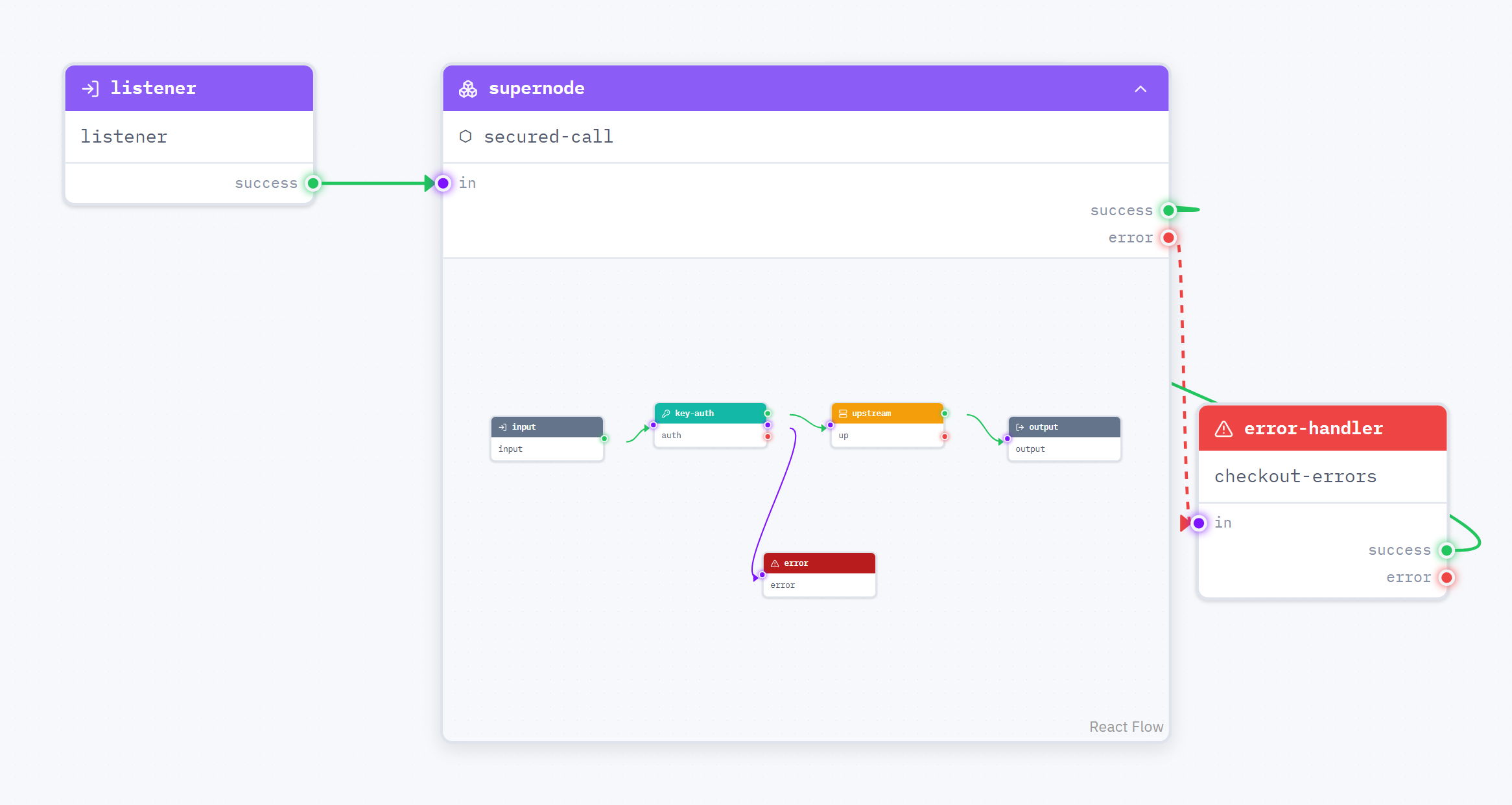
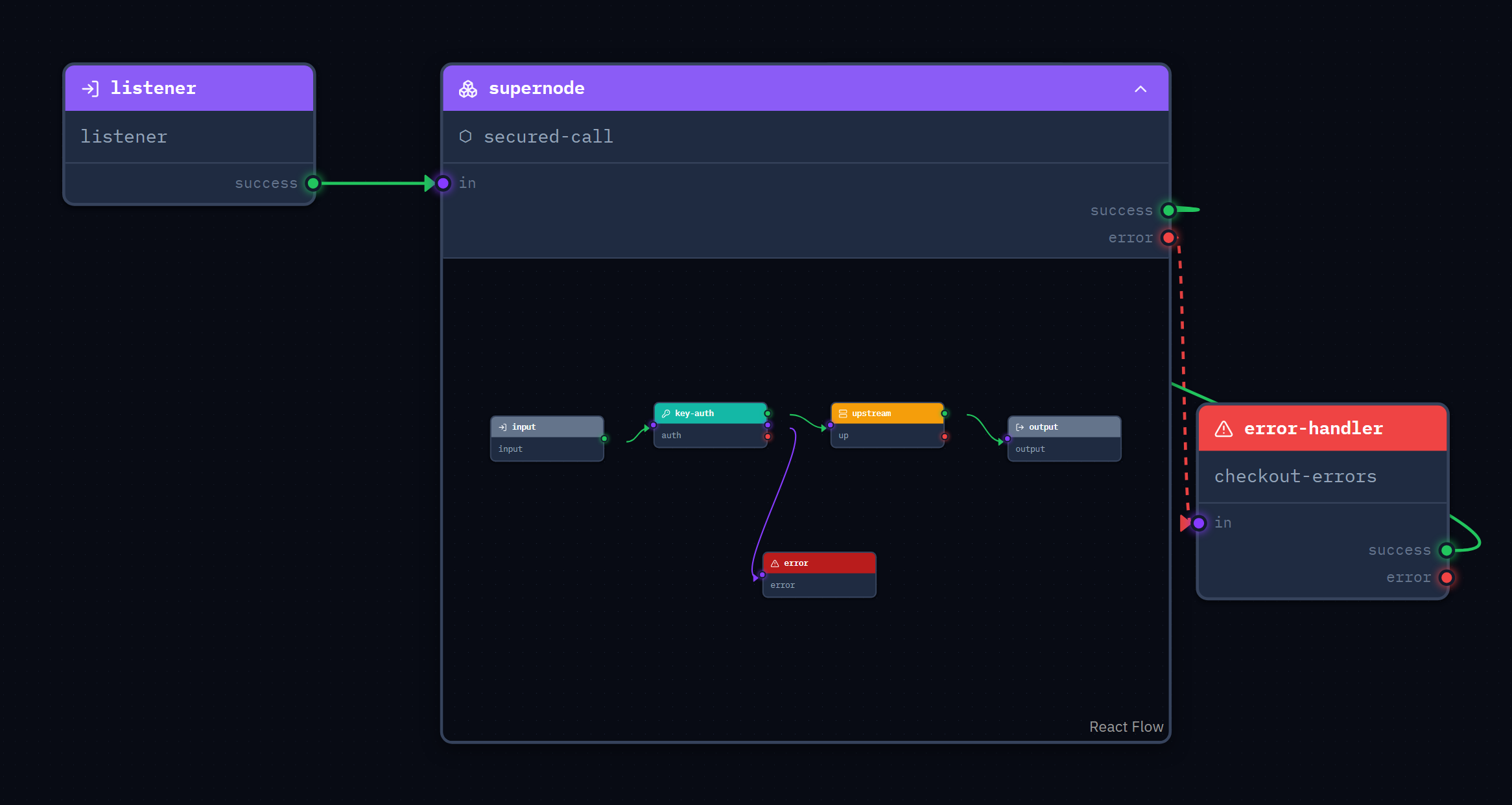
In the web UI, a supernode instance on the policy canvas carries an expand chevron in its header. Clicking it grows the node in place into a zoomed-out, read-only preview of the definition's inner graph — boundary nodes included — floating above its neighbors with the instance's edges still attached; clicking again folds it back. The preview is a glance, not an editor: nothing inside is clickable or draggable, and editing still happens in the definition's own canvas (the Supernodes section of the sidebar). Expansion is per-session editor state — it is never written into the policy, mirroring how expansion is never persisted on the gateway side. If the instance references a definition that no longer exists (deleted from the library while an unsaved instance still points at it), the preview shows an inline supernode '<name>' not found message instead of a graph.
An instance's exits are exactly its definition's boundaries
An instance exposes one outer port per type: output boundary in its definition (success, alias out, for the output-id boundary; the id itself for any other, per named output ports above) plus one per type: error boundary (error for the default error-id boundary; the id itself for any other, per named error ports above) — nothing else. An instance never exposes an outcome port directly: those belong to inner nodes, and the definition must route them to a boundary itself. An edge leaving the instance on a port its definition doesn't derive is rejected, as is a second edge from any one exit:
policy 'p': unknown port 'denied' on supernode instance 'sec' — supernode 'secured-call' exposes: success, error
(that message assumes sec references a definition with only the default output/error boundaries; a definition that also declares a denied output boundary makes sec.denied valid — and, per the mandatory-wiring rule above, required — and a definition that also declares a named error boundary such as auth-error makes sec.auth-error valid, optional to wire, just like sec.error.)
Correspondingly, every success/outcome port of every inner node must be wired inside the definition — to another inner node, or to one of its output boundaries or one of its error boundaries. This is checked when you save the definition, so the error names the definition rather than surfacing later as a puzzling compile failure on whichever policy happens to instantiate it. All such violations are reported together. Inner error ports stay exempt — the black-box rule below covers them.
Black-box error routing
Only the default error boundary — the type: error node with id error — carries the black-box guarantee. auth.error -> error.in above is an explicit edge the definition itself wires — nothing implicit about it. The implicit case is up: its error port is left unwired inside the definition entirely. At expansion time, any inner node with no error edge of its own gets an implicit edge straight to wherever the policy connected the instance's default error port — but only if the policy wired that port. If it didn't, those unhandled inner errors aren't silently swallowed; they fall through to the policy's error_handler, or a 500 if there isn't one.
Any other named error boundary (an auth-error boundary, say) gets no such default: an inner node's error only lands there via an explicit inner edge (some_node.error -> auth-error.in). And if a definition renames its default boundary away from error entirely — so every error boundary has a non-error id — the black-box default disappears along with it: every inner node's error port must then be wired explicitly, to one of the definition's (now all explicitly-targeted) error boundaries, or that error falls through to the policy's error_handler/500 once expanded, the same as an unwired default would. Either way, the policy wiring the instance only ever sees as many error exits as the definition declares boundaries for, no matter how many inner nodes could fail.
Compile-time expansion
Supernode instances are macro-expanded, not executed as a nested engine: before a policy is compiled, every instance is inlined into the flat node graph the engine already knows how to run — engine, metrics, and trace code are unmodified. Each inner node n from an instance sec becomes sec/n in the compiled graph, and inner edges are rewired with that prefix on both ends. Outer edges into the instance's in port and out of each of its output-derived ports and error are spliced onto the corresponding inlined boundary edges.
This is visible, by design, wherever node ids show up:
- Metrics carry labels like
node_id="sec/auth". - Debug traces record each inner step individually, grouped under the instance id.
- Error records (
GatewayError.node_id) show exactly which inner node failed, so anerror-handlertemplate can reportsec/authrather than a generic instance failure.
Expansion happens fresh on every compile; the stored config in gateway.yaml, the Admin API, and etcd all keep the compact type: supernode reference form. The expanded graph is never persisted.
V1 limits
- No parameters. A supernode definition is fixed; the only per-environment variation is
${VAR}interpolation, which still works inside a definition the same as anywhere else ingateway.yaml. - No nesting. A supernode cannot reference another supernode. Multiple instances of the same definition are fine — each gets its own namespace — but the definitions themselves are flat.
- Single input. Exactly one
inputboundary; both the outputs side and the errors side support multiple named boundaries (see Named output ports and Named error ports). - Node ids inside a definition may not contain
/. Output boundary ids may not reuseinput,error,in,out,success; error boundary ids may not reuseinput,output,in,out,success— each kind's reserved list excludes its own default name but includes the other kind's.
Export and seeding
SupernodeConfig is part of GatewayConfig, so supernodes travel with the rest of the config wherever it does: GET /api/config/export (see the Admin API guide) includes a supernodes: section alongside routes: and policies:, and a gateway.yaml that has one seeds it into a fresh instance or etcd cluster on first load — no separate export/import path to remember.